A First Run on an Unfamiliar Route
Plan a first run on an unfamiliar route with a simple way to learn its layout, choose a comfortable pace, and decide what to remember for next time.

A first run on an unfamiliar route is easier to enjoy when you treat it as a chance to learn the place, not a test of navigation. Choose one feature to notice, keep your effort comfortable, and let the route’s feel—not a memorized sequence of turns—shape the outing.
Set a learning goal
Give the outing one modest purpose: notice how the surface feels, see where the path meets the street, or learn whether the area is quiet enough for an easy run. A single goal keeps your attention on the surroundings without turning the run into a scouting assignment.
Before setting out, decide what “comfortable” means today. You might be able to speak in short sentences, or you might alternate easy jogging with walking. There is no need to match a pace shown by an app or another runner; the point is to leave enough attention for the new surroundings.
Read the place as you go
Notice broad features rather than trying to memorize a chain of turns. Look for changes in surface, shade, slope, noise, and foot traffic. These cues help you decide whether a section suits you without keeping your eyes fixed on a phone.
Let the route’s character inform your choices. A paved path may feel predictable underfoot, while gravel or roots call for a more attentive stride. Near a busy road, use a sidewalk or marked crossing where available, and follow posted signs in parks and public spaces.
Keep your phone available for orientation, but stop somewhere out of the way before checking it. A saved map can clarify a confusing point; it cannot tell you whether a path feels pleasant, crowded, or comfortable to run.
Use a simple check
- Surface: Notice whether the path is smooth, loose, muddy, or uneven; if it feels secure, continue at an easy effort, but if footing is uncertain, slow down or choose a clearer public path.
- Traffic: Check whether vehicles and cyclists are easy to anticipate; if the route feels separated and orderly, proceed, but if interactions are hard to read, walk or move to a quieter section.
- Crossings: Look for a marked crossing or clear signal; if one is available, use it, but if crossing conditions are unclear, wait or choose another route.
- Comfort: Notice whether heat, wind, noise, or crowding is changing how the run feels; if you remain comfortable, keep going gently, but if not, slow to a walk or head back toward a familiar public place.
- Attention: Check whether you can stay aware of the path and people around you; if so, keep running easily, but if you feel distracted or uncertain, walk while you get oriented.
- Access: Look for signs, barriers, or a closed entrance; if the way is clearly open to the public, follow the posted route, but if access is restricted or ambiguous, do not enter and choose an open path.
What should you notice?
Should you track pace on a new route?
You can, but pace is less useful than a comfortable effort when the surface, turns, or traffic are unfamiliar. If checking a watch pulls your attention from the path, leave the display alone and run by feel.
How can you remember the route?
Afterward, write down one or two useful observations in a notes app, such as “gravel begins after the playground” or “the quiet section is beside the library.” Keep the notes descriptive; you do not need to reconstruct every turn.
What if the route feels uncomfortable?
Slow down, walk, or return toward a familiar public area rather than pushing through discomfort. If you feel unwell or have a health concern, stop and seek appropriate help; for recurring concerns, ask a qualified health professional.
Is walking part of the run?
Yes. Walking gives you time to observe a crossing, settle your breathing, or decide whether a section suits you. It is a practical way to learn a new place while keeping the outing manageable.
A worked outing
Say you are planning an invented first visit to a public greenway. Your starting inputs are a phone with an offline map, running shoes suited to the surface you expect, and a goal of learning whether the main path feels comfortable; you have no target pace or distance.
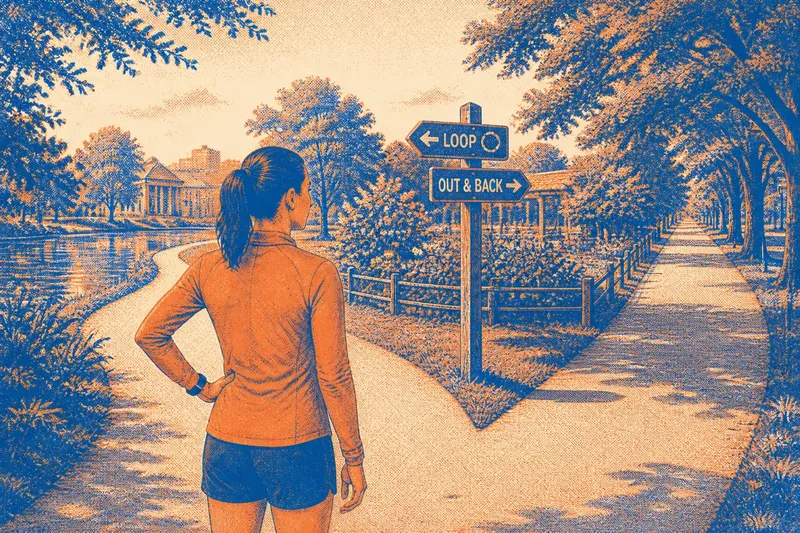
You begin at the signed public entrance and jog gently, watching the surface and how the path meets nearby streets. At a fork, the signs point to two open public paths, but the map is unclear. You step aside, check the map, and see that one branch continues beside a busy road while the other stays within the greenway.
You choose the greenway branch because it better fits your learning goal. When the gravel becomes loose, you slow to a walk and note that the surface changes beyond the fork. The resulting decision is useful even if you do not cover the planned portion: next time, you can start with the paved section and decide whether to explore the gravel after seeing its condition.
Keep a useful note
When you finish, record the details that would change your next decision: where the surface changed, whether signs were easy to follow, and which stretch felt comfortable. If the route was hard to read, note the exact point where you became unsure; if it felt straightforward, remember the feature that made it so.
For a first run on an unfamiliar route, that small record is more useful than a perfect map in your memory. It gives you a concrete starting point for the next visit while leaving room to choose a different pace, surface, or direction.